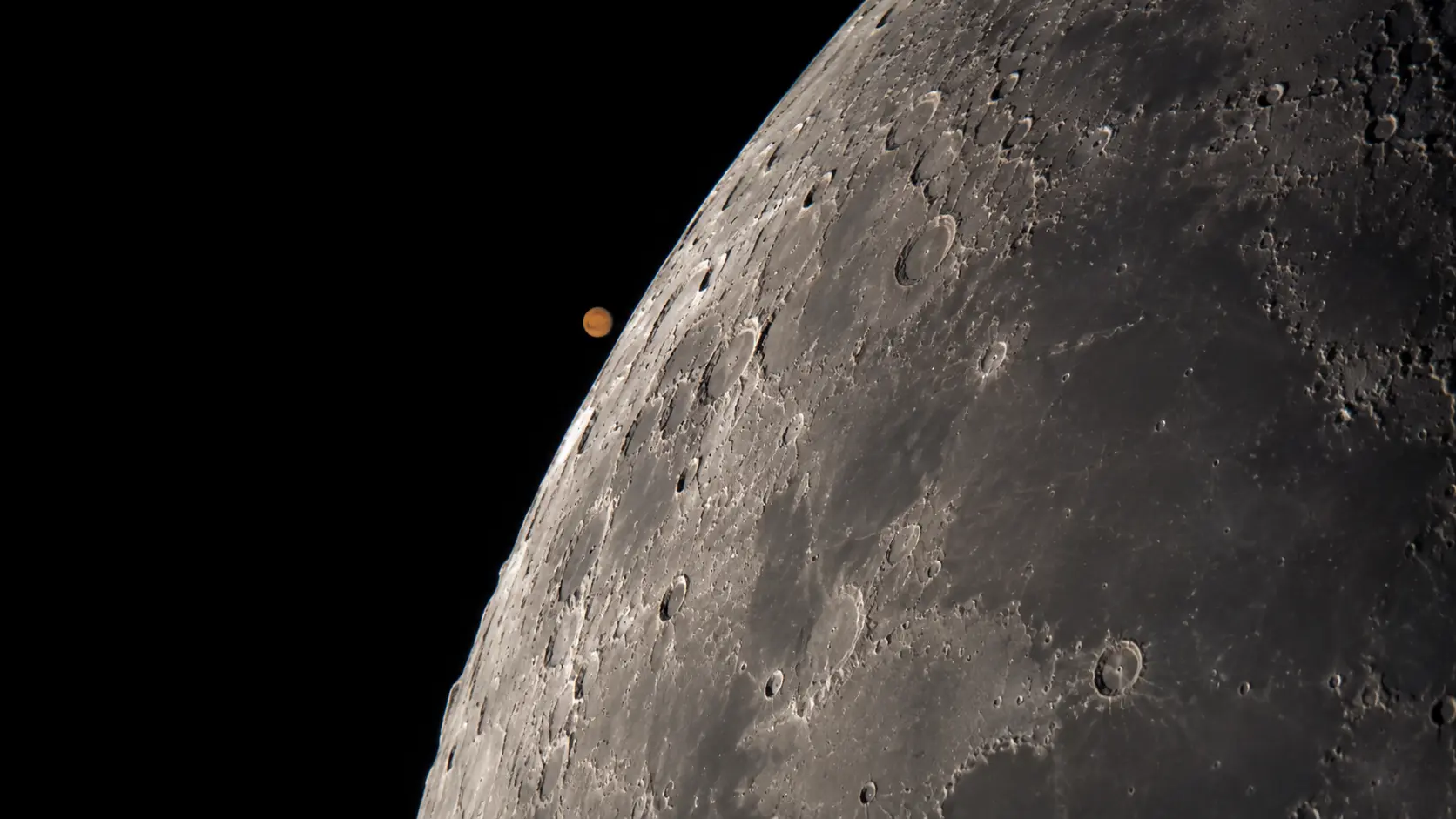
Most of what we photograph will still be there next month. An occultation will not. When the Moon passes directly in front of a planet, the interesting part, the moments of disappearance and return, is measured in seconds, and it happens on a schedule the sky sets, not you.
The rehearsal
For a fixed-time event we rehearse like a launch crew. Two evenings before, we ran the full sequence against the Moon alone: framing, exposure, focus routine, recording start. The predicted disappearance time for our coordinates was accurate to the second, which meant our only job was to be boringly ready ahead of it.
Forty-one seconds
Mars took forty-one seconds to slide behind the lunar limb at our longitude. On the recording you can watch the planet’s tiny disc flatten against the dark edge and dissolve, which never stops feeling like a magic trick played with real worlds. An hour later it emerged from the bright limb, harder to catch and somehow even better.
Why we chase these
An occultation is the rare event that makes the clockwork of the solar system visible in real time. Nothing we do communicates orbital motion to a retreat group faster than showing them one. The next good lunar occultation for our region is already on the studio calendar, and the rehearsal checklist is already printed.