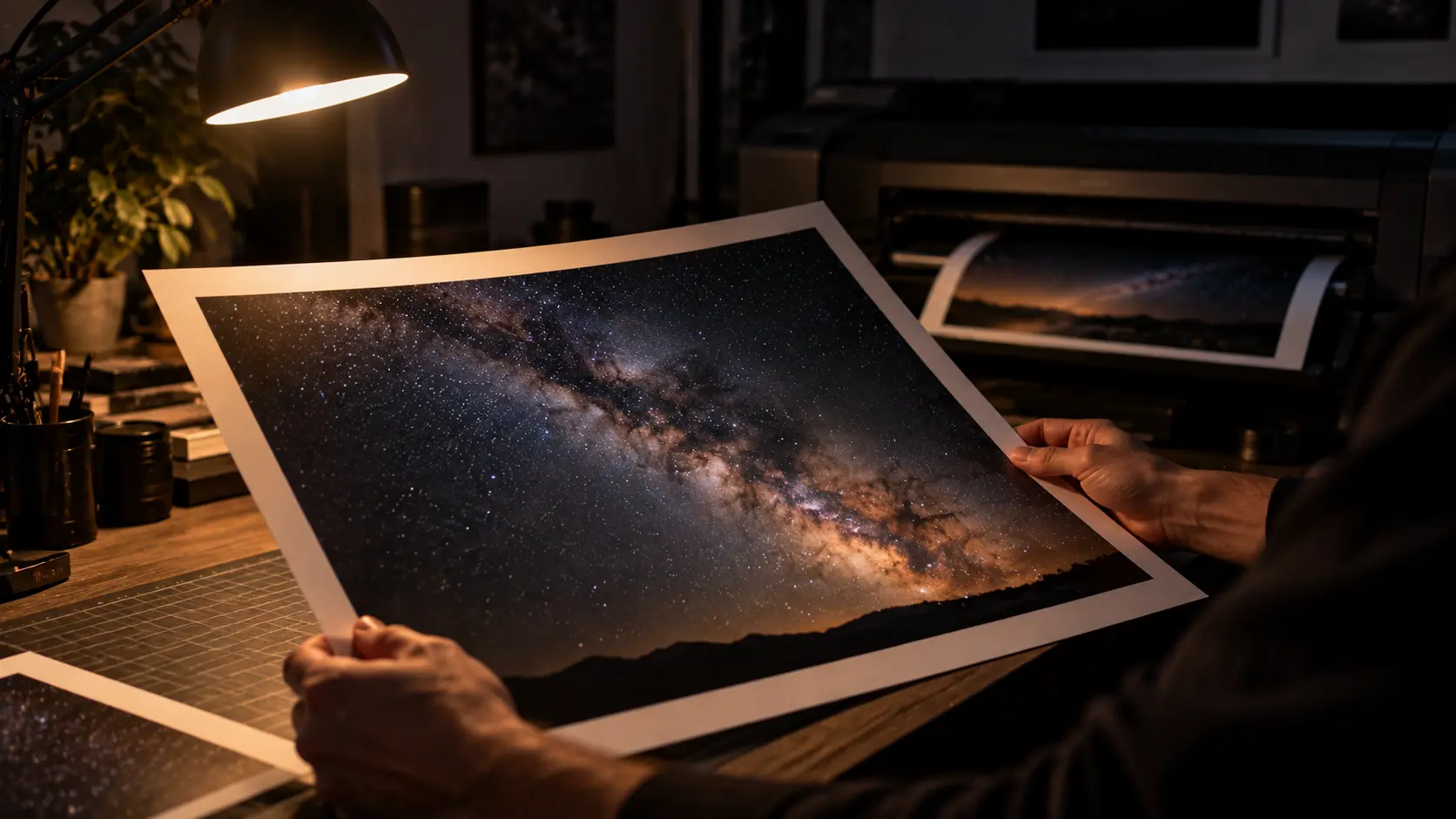
A finished astrophoto lives happily on a backlit screen, where blacks are free and contrast is infinite. Paper plays by different rules. Every print we sell goes through a separate preparation pass, and that pass is longer than most people expect.
Shadows are the whole game
The night sky is mostly shadow detail, exactly the region where printing is weakest. Faint nebulosity that reads clearly on screen can sink into flat black ink on paper. So the print file gets its shadows lifted and separated deliberately, in a way that would look slightly wrong on screen but lands correctly on paper.
Proof, adjust, proof again
We proof on the actual paper stock, never just on a calibrated display. The first proof almost always comes back with the star field too dense and the background a shade greener than intended. Two or three rounds of small corrections later, the print stops being a copy of the screen image and becomes its own object.
Why matte, usually
Glossy stock gives deeper blacks, but it turns every lamp in the room into a reflection floating over the Milky Way. Matte papers give up a little contrast and in exchange the image stays visible from every angle in normal home lighting. For subjects that are ninety percent darkness, that trade wins almost every time.
The file that goes to the printer is the fourth or fifth version of the image. Nobody who buys the print ever sees the others, which is exactly the point.