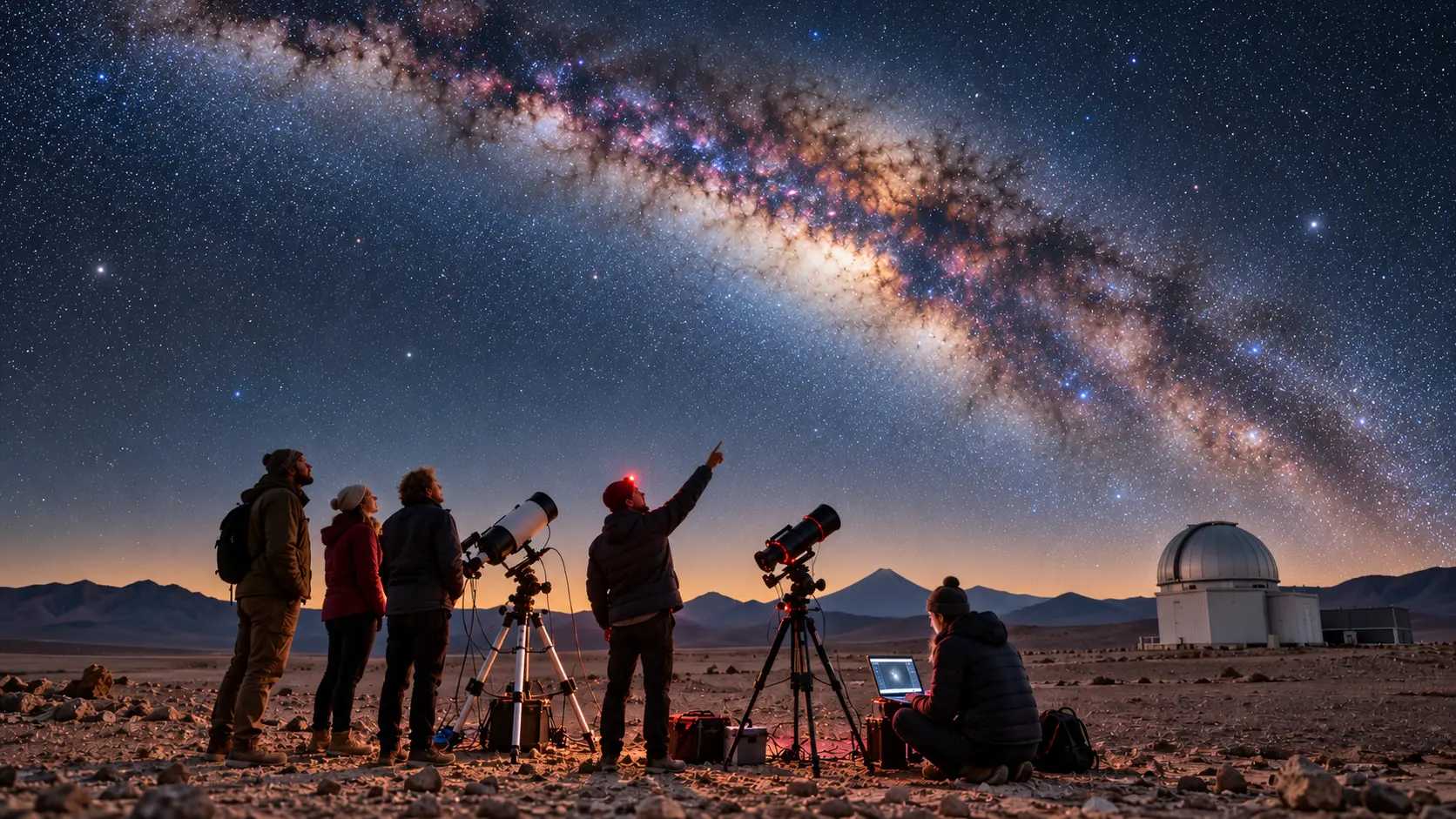
The retreat
Four days at the observatory.
You arrive a guest and leave an astrophotographer. Days for processing lessons and desert naps, nights on the platform with the rigs running. Camila keeps the schedule, the sky does the rest.
- Duration – 3 nights, 4 days at the Atacama observatory
- Group size – 4 to 8 participants
- Includes – telescope time, all equipment, full board and transfers
- Next intake – September 2026
The Itinerary
How the days run.
Every schedule bends to the sky. This is the shape of a typical intake.
Day 01
Arrival & first light
Transfers from Calama, sunset orientation on the platform, and your first hours at the eyepiece after dark.
Day 02
Deep-sky night
A full night of guided imaging on the big rigs. Sleep late; the afternoon is for calibration basics.
Day 03
Your target
You pick the object. We plan the capture together and shoot it through the night, your data, start to finish.
Day 04
Processing & departure
A morning turning your frames into a finished image with Daniel, then transfers back with your files in hand.
By the nunmbers
The Facility
One telescope on one exceptional site, paired with a 61-megapixel cooled full-frame CMOS. These four numbers explain most of our results.
610 mm
Primary Instrument
2,900 m
Site Altitude
0.8″
Median Seeing
~320
Clear nights a year

I came with a camera I barely understood and left with a Milky Way panorama that’s now two metres wide in my office. The 3 a.m. coffee helped.
get Help
Before you ask
Answers to the things clients ask most before a commission.
Neither. Every rig, camera and filter is provided, and the group is small enough that beginners and experienced imagers each get what they need. If you’d rather shoot on your own setup, bring it; there’s bench space and power on the platform.
At this site, statistically unlikely: around 320 clear nights a year. If a night does close over, the itinerary flexes, processing moves up, and the clear nights work harder.
The observatory sits at 2,900 metres. Most visitors feel nothing worse than a slow first evening. We pace day one gently, keep water everywhere, and the nearest clinic is forty minutes away, unused so far.
Next Intake
Eight spots. One sky.
Tell us which intake suits you and we’ll hold a place while you decide.