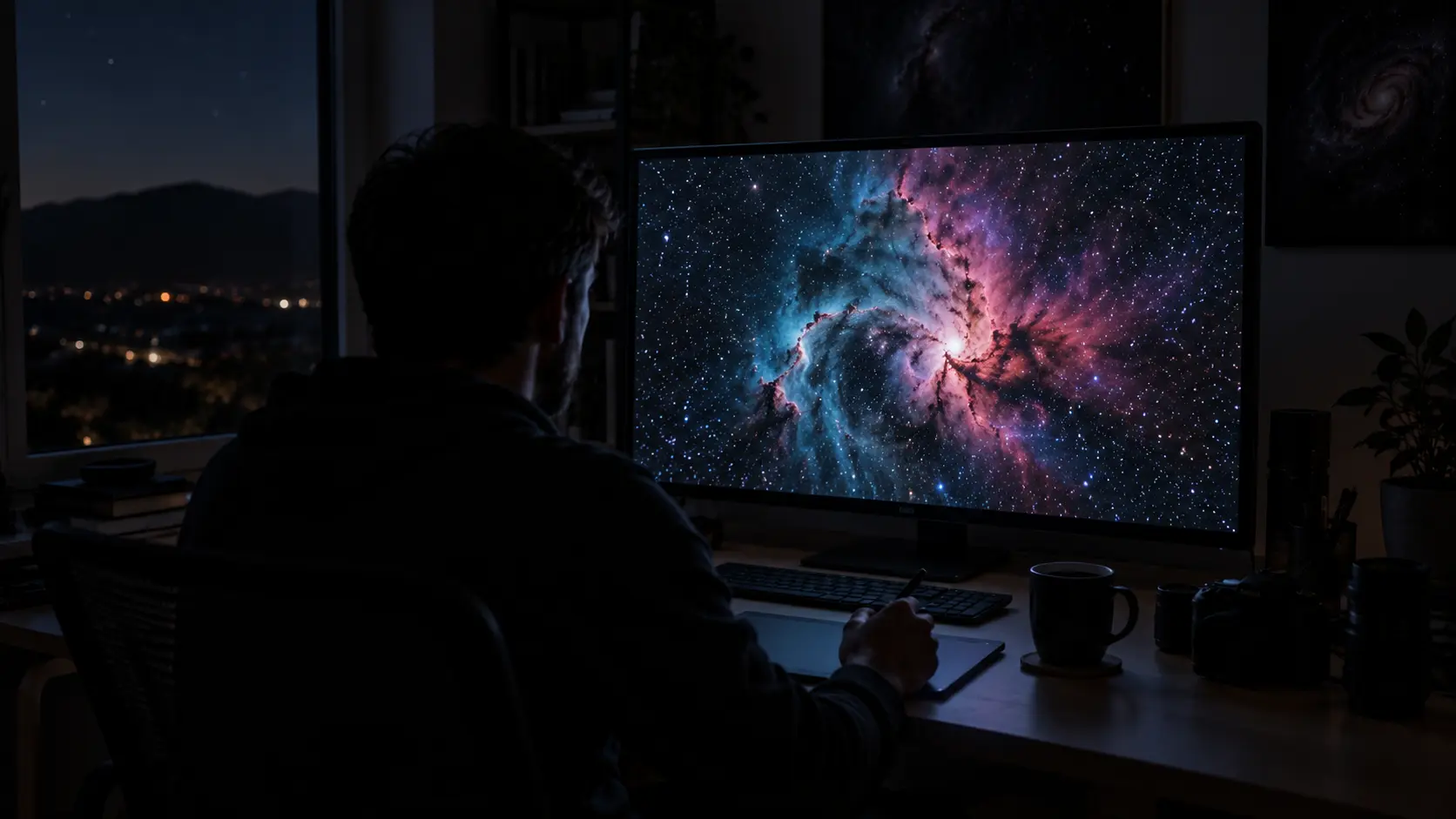
The most common misconception about deep-sky photography is that somewhere there is a single long exposure that looks like the finished image. There is not. The finished image is an average of many ordinary ones, and the workflow that gets you there is more bookkeeping than magic.
Calibration comes first
Before the sky frames mean anything, we shoot frames of nothing: darks with the cap on to map the sensor’s own noise, and flats against an even light to record dust and vignetting. Subtracting these from every exposure is dull, invisible work that decides how clean the final image can ever be.
Registration and rejection
The software aligns all two hundred frames to sub-pixel accuracy, then compares them statistically. A satellite trail exists in one frame but not the other hundred and ninety-nine, so the outlier gets voted out automatically. This is why stacked images look so quiet: the noise disagrees with itself and cancels, while the nebula agrees with itself and stays.
The stretch
The stacked result still looks almost black, because the interesting signal lives in a thin sliver of the data. Stretching pulls that sliver apart gently, over many small steps. Push too hard and the stars bloat and the background turns to mud. This stage is where processing becomes taste, and where two imagers with the same data produce two different pictures.
None of the steps is difficult on its own. The craft is in doing all of them carefully, in order, every single time.