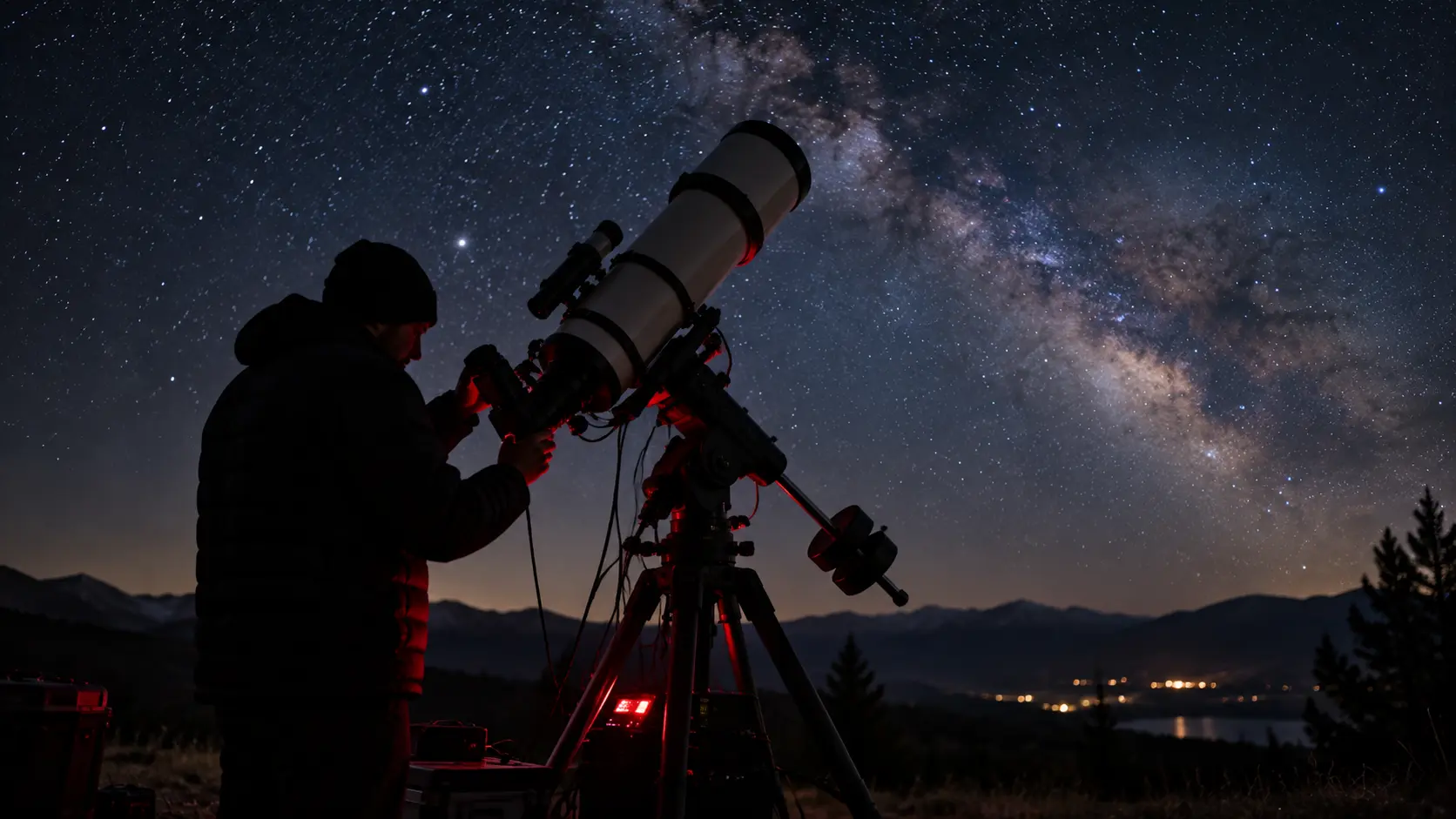
Saturn rises late this season, so this was always going to be a night that ended at dawn. We set up the long focal length rig while the planet was still tangled in the murk above the horizon and spent the wait collecting dark frames and coffee.
Waiting out the atmosphere
Planetary imaging is a patience game played in milliseconds. The planet sat in a fast airstream for the first two hours, and on the screen it breathed and smeared like something underwater. We recorded anyway. Short bursts, thousands of frames, knowing most would be thrown away.
The steady window
Around three in the morning the jet stream shifted, and for roughly forty minutes the seeing settled to the best we have had all year. In those bursts the Cassini Division snapped into view along the whole visible arc of the rings, and the shadow of the globe on the rings behind it turned knife sharp. Those forty minutes produced the only data that made the final stack.
What the numbers looked like
Twelve thousand frames captured, roughly nine hundred kept. That ratio sounds wasteful until you compare the stacked result with any single frame from the night. Stacking the sharpest few percent is the entire craft, and the discard pile is the price of the picture.
We drove home in daylight. Worth it.