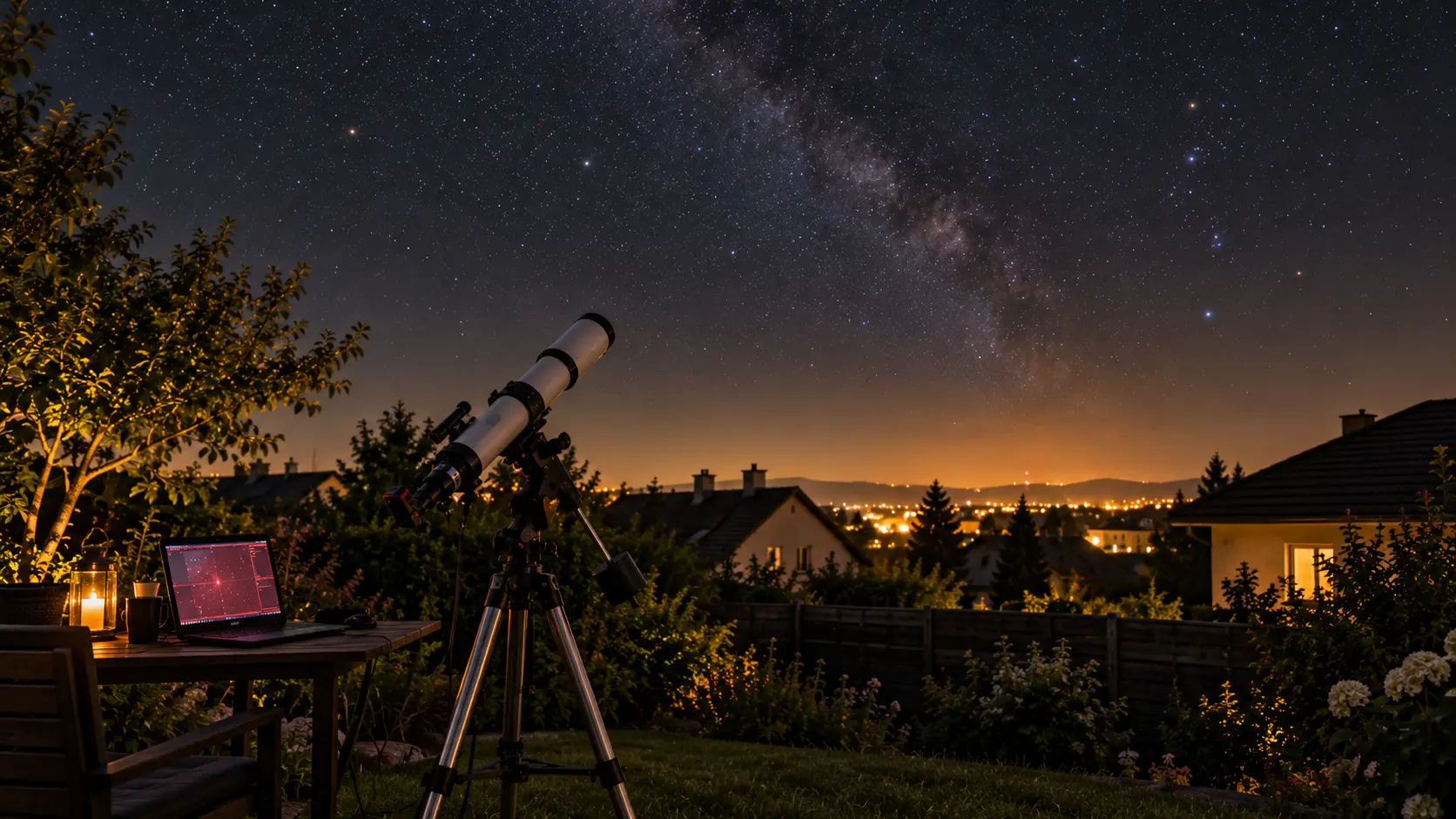
Every winter we get the same question: is deep-sky imaging even possible from town? Last month we set out to answer it properly. One rig, one backyard at Bortle 7, one target: the Orion Nebula.
The setup
We deliberately kept it modest. A small apochromatic refractor, a cooled one-shot color camera, and a dual narrowband filter that passes hydrogen-alpha and oxygen-III while rejecting most of the sodium and LED glow that washes out suburban skies. No premium mount, no autoguiding heroics.
What the filter changes
Without the filter, our 30-second test frames showed an orange sky with a faint gray smudge in the middle. With it, the smudge became structure: the bright core, the curling wings, the dark lane of the Fish’s Mouth. Light pollution filters don’t create signal, they protect the contrast you already have, and on emission nebulae like M42 that’s enough to change everything.
The numbers
Three hours of total exposure across two evenings, in 60-second subframes. About one frame in eight was lost to passing clouds and one enthusiastic neighbor’s security light. After stacking and a careful stretch, the result held its own against images we’ve made under far darker skies.
The honest conclusion: the sky you have is better than the sky you’re waiting for. Start where you live, learn the process, and save the dark-site trips for the targets that truly need them.